
Every major life transition eventually asks the same question: Who am I now?
I spent twenty years watching what happened to people at the thresholds no institution was designed to address. The promotion that came with no identity preparation. The workforce displacement that no EAP could hold. The inheritance that arrived with no psychological infrastructure to receive it. The AI transformation that nobody named as a confidence problem before naming it as a skills problem.
The programs offered from CP4CD were built because that gap is real, it is large, and it is almost entirely unaddressed by the existing professional development landscape.
Thank you for being here. Whoever you are at the threshold, this work was built with you in mind.
— Dr. Diamond D. DuBose
Ten programs. One conviction.
The gap between who you are and who you are becoming is real — and it is closeable.
Every CP4CD program is built on validated behavioral-science instruments, delivered in cohort format, and assessed with pre/post measurement. They are not workshops. They are developmental experiences — structured, sustained, and designed to produce outcomes that last.
The Research Foundation
CP4CD's Human Development Programs operationalize the framework Dr. DuBose proposed in her doctoral research (Pepperdine, 2024) — applied to the work of human development itself. But the program portfolio did not arrive by intuition or market trend. Each program exists in response to a documented societal problem that has not been solved by the institutions equipped to solve it.
The portfolio emerged from a structured needs analysis Dr. DuBose conducted across the societal problems where developmental response is most acutely missing. The analysis combined three lenses: the grounded-theory diagnostic discipline of her dissertation research, two decades of learning and development practice inside the institutions where these populations work, transition, and are displaced, and the DEI lens that taught her to see systemic societal barriers as part of the diagnostic frame — not just individual development gaps inside organizations. The question was not “what development products will sell?” The question was: which societal problems are producing measurable harm to specific populations, where existing developmental infrastructure has either failed to respond or never existed in the first place?
The answers surfaced consistently across the analysis. The intergenerational transfer of $47 trillion in wealth to women is happening without the behavioral and psychological infrastructure designed for the women receiving it — a societal problem with measurable financial, emotional, and intergenerational consequences. The U.S. Surgeon General declared loneliness a public health crisis comparable to smoking fifteen cigarettes a day, with no scaled cohort-based developmental response built since. Tens of thousands of mid-career federal workers in the DMV are navigating displacement and identity disruption without coaching infrastructure designed for it. AI is restructuring professional identity faster than any framework for navigating it has emerged. The pattern is consistent across the portfolio: documented societal problems, measurable population-level harm, no structural developmental response.
The methodology that follows from the needs analysis is what makes the response credible. A program designed to address a societal problem must be testable against that problem — not just against participant satisfaction. Every program is grounded in validated psychometric instruments rather than self-report. Every cohort uses pre/post outcome measurement to test whether substantive change occurred. Six and twelve-month longitudinal follow-ups test whether the change held. The cohort delivery model — informed by Dr. DuBose's MEd in Human Resource Development (GWU), her design work on Fannie Mae University, and the workforce development infrastructure she built for federal agencies — is the mechanism that compounds individual change through community accountability. The validated-instrument grounding allows cohort outcomes to be compared against population baselines, which is what makes “moving the underlying statistics” a measurable claim rather than a rhetorical one.
Dr. DuBose's DEI experience clarified the principle the Programs portfolio is designed around: developing individuals inside systems matters, but the systemic societal barriers those systems sit within shape whether individual development can translate into population-level change. Programs that ignore the systemic dimension produce individual benefit without societal impact. Programs designed to develop individuals across the institutions and populations affected by the same societal problem can produce both — and that is the theory of change the Programs portfolio is built to test.
What the portfolio represents structurally is the integration of two commitments Dr. DuBose has held across her career: the practitioner's commitment to evidence-based developmental rigor, and the equity commitment that has shaped her work across two decades of HR-discipline practice. That commitment is not narrowly identity-bound — it extends to any population whose access to developmental infrastructure has been systematically constrained, whether by economic, geographic, demographic, cultural, or institutional barriers. CP4CD is where that integration is operationalized at scale, with equitable access embedded as a design requirement in every program rather than as an optional feature.
The needs analysis identified the societal problems and the populations most affected by them; the equity architecture — Tier 1 fully-subsidized seats reserved in every cohort, equity-pricing tiers across every program, facilitators whose backgrounds reflect the populations served — is what guarantees that the developmental response is available to the populations whose statistics most need to move. This is not inspirational programming with equity language layered on top. It is the structural application of a measurement-and-execution framework to societal problems whose populations have been historically underserved by the institutions equipped to address them.
What We Stand For
Evidence, not trend
Every program claim is traceable to peer-reviewed research or validated assessment outcomes. We do not follow the coaching industry's trend cycle.
Community as medicine
Cohort-based delivery is not a format choice. It is the mechanism of change. People develop in community, not in isolation.
Access as architecture
Equity is a structural requirement built into every program's pricing, design, and every partnership agreement — not a marketing feature.
Partnership ecosystem
Referral partners, institutional licensors, certified facilitators, and associate consultants — four tiers of structured relationships that compound the reach of every practice.
Our Equity Commitment
Every program offers four pricing tiers — from fully subsidized through institutional sponsorship. A minimum of 10-20% of seats in every cohort are fully funded through grants and premium-tier contributions. Facilitators whose backgrounds reflect the populations served is a practice quality requirement, not a target. Programs designed for specific communities are built with those communities, not for them. Smartpreneur Consulting™ offers an equity-adjusted audit rate ($200-$300) for BIPOC-owned and immigrant-owned businesses. The Grounded Leader™ reserves selected coaching slots for leaders whose dismantled-work disruption affected them precisely because of identity-based roles.
Tiers 1–2 (equity-priced) and Tier 4 (institutional sponsorship) available for every program. Minimum 10–20% of seats in every cohort are reserved for Tier 1 participants.
The Ten Programs
P1 — Identity in Transition
Cohort-based identity reconstruction work using validated transition-stage assessment. Includes Bridges Transition Model framework, ACT-informed identity work, and structured values-excavation exercises. Companion: P1 Identity in Transition Workbook ($47).
WHO IT'S FOR
Adults navigating career change, federal workforce displacement, or life-identity disruption — the population whose work or institutional context shifted, leaving them to renegotiate professional identity.
Tier 3 Standard pricing: $2,497-$7,997 · Equity-priced and institutional tiers available
P2 — The Emotional Edge
Cohort-based EI development using licensed EQ-i 2.0 and EQ 360 assessment battery (administered with certified facilitator). The licensed EI assessment debrief is the program’s substantive value driver. Workbook content included with program (no separate workbook purchase).
WHO IT'S FOR
Professionals seeking emotional intelligence development that translates to leadership presence and team effectiveness — not the surface EI work most programs deliver.
Tier 3 Standard pricing: Available on inquiry · Equity-priced and institutional tiers available
P3 — Wealthy Woman™
Cohort experience addressing the psychological dimension of women’s financial confidence — the self-limiting money beliefs, the inherited money patterns, and the unconscious financial behavior shaped by lived experience. Includes pod-based small-group work, individual coaching sessions, and full assessment battery. Companion: Wealthy Woman Financial Identity Workbook ($67) and free Wealthy Woman Pre-Program Reflection for waitlist signups.
WHO IT'S FOR
Women managing inherited wealth, navigating financial transitions post-divorce or business exit, or developing the psychological infrastructure to receive significant wealth. The $47 trillion intergenerational wealth transfer to women is happening without the behavioral and psychological infrastructure designed for the women receiving it.
12-week cohort · 14 women per cohort · Tier 3 Standard pricing: $3,497-$9,997
Public launch: Spring 2027 (founding cohort priority enrollment opens Fall 2026)
P4 — The Belonging Blueprint™
Distinctive engagement architecture combining 6-week structured onboarding plus ongoing membership community. Both elements integral to program design. Full assessment battery including UCLA Loneliness Scale V3, Social Connectedness Scale-R, MOS Social Support Scale, Vulnerability Scale (CP4CD adaptation), and Reciprocity Orientation Scale. P4 also serves as the alumni community infrastructure for graduates from all other programs. Companion: free P4 Belonging Blueprint Catalog.
WHO IT'S FOR
Adults experiencing disconnection, loneliness, or loss of community infrastructure. The U.S. Surgeon General declared loneliness a public health crisis comparable to smoking fifteen cigarettes a day — P4 is CP4CD’s structural developmental response.
6-week structured onboarding + ongoing membership · Tier 3 Standard pricing: $47-$97/month
Public launch: Spring 2027 (founding cohort priority enrollment opens Fall 2026)
P5 — Whole Life Wealth
Cohort-based mind-body-money integration program. Addresses body awareness, financial wellbeing, stress reflection, and interoceptive awareness work alongside conventional wealth-building practice. Companion: Whole Life Wealth Workbook ($47).
WHO IT'S FOR
Adults building wealth across the four dimensions — financial, physical, relational, and purposeful. Addresses the integration work that financial-only and wellness-only programs leave unaddressed.
Tier 3 Standard pricing: $3,497-$8,997
P6 — Human in the Machine
Cohort program for professional AI fluency anchored in AI confidence and identity work rather than tool tutorials. Generation-specific application sections. Includes AI Anxiety Scale (AIAS) assessment and structured AI-proof identity statement development work. Companion: Human in the Machine Workbook ($47) and free P6 Enterprise Decision Guide for organizational buyers.
WHO IT'S FOR
Professionals navigating AI disruption — across all generations and functions. AI is restructuring professional identity faster than any framework for navigating it has emerged.
FPY Track A available for youth-institution partnerships
Tier 3 Standard pricing: $1,997-$5,997
P7 — The Empathy Effect
Cohort program using licensed IDI (Intercultural Development Inventory) assessment under qualified administrator certification. Track 1 develops cultural empathy and inclusive leadership practice; Track 2 supports professional identity navigation for leaders from underrepresented backgrounds. Workbook content included with program (no separate workbook purchase).
WHO IT'S FOR
Two-track architecture serving distinct populations. Track 1: leaders developing cultural empathy and inclusive practice. Track 2: leaders from underrepresented backgrounds navigating professional belonging and identity in majority-culture institutions.
Tier 3 Standard pricing: Available on inquiry
P8 — Groundwork
Cohort program for masculine identity development. Foundation program in the Relational Health Ecosystem (P8 → P9 → P10). Belief-mapping exercises, generational pattern recognition work, and structured identity reflection.
WHO IT'S FOR
Men navigating contemporary masculine identity work. Addresses the developmental work that most men never have structured access to.
Tier 3 Standard pricing: Available on inquiry
P9 — Root & Bloom
Cohort-based relational health program with two phases. Includes attachment pattern reflection, generational pattern recognition work, belief mapping exercises, and elder storytelling components. Companion: Root & Bloom Workbook ($67) and free Root & Bloom Pre-Program Reflection for waitlist signups.
WHO IT'S FOR
Couples and individuals doing relational health development work — attachment patterns, generational transmission, belief work, communication. The 20-week program length reflects the depth and pace the work actually requires.
20-week cohort · Tier 3 Standard pricing: Available on inquiry
P10 — Digital Edition
Brief add-on program addressing digital relational behavior patterns through CP4CD-developed DRBI (Digital Relational Behavior Inventory) measuring four subscales: Intentionality, Communication Quality, Digital Boundaries, Online-to-Offline Transition Readiness. Companion: P10 Digital Edition Workbook ($47).
WHO IT'S FOR
Adults navigating digital relational behavior in dating, friendship, and family connection. 4-session add-on across 4-6 weeks; free for P8 and P9 graduates per Relational Health Ecosystem.
Standalone enrollment: Tier 3 pricing available on inquiry
Cross-Program Pathways
Programs are designed to compound. Four sequence ecosystems organize the cross-program pathways that produce the multi-program lifetime developmental arc CP4CD’s portfolio is designed to support:
The Universal Sequence
P1 Identity in Transition → P4 The Belonging Blueprint → P2 The Emotional Edge → P7 The Empathy Effect (Track 1). The sequence available to any cohort participant for full developmental progression across identity, belonging, emotional intelligence, and cultural empathy.
The Women’s Wealth Sequence
P3 Wealthy Woman → P4 The Belonging Blueprint → P5 Whole Life Wealth. Calibrated to women’s financial identity development across the three programs.
The Relational Health Ecosystem
P8 Groundwork → P9 Root & Bloom → P10 Digital Edition. The integrated relational health development arc spanning identity, partnership, and digital relational behavior.
The AI Fluency Sequence
P6 Human in the Machine → cross-practice routing to The Grounded Leader™ (for senior leaders) or Smartpreneur Consulting™ (for business owners building AI-enabled operations).
Cross-program enrollment receives automatic discount: 10% off Tier 3 Standard Enrollment for the second program; 15% off Tier 3 for the third and subsequent programs. The discount applies through automated tracking — no manual application required.
Digital Product Portfolio
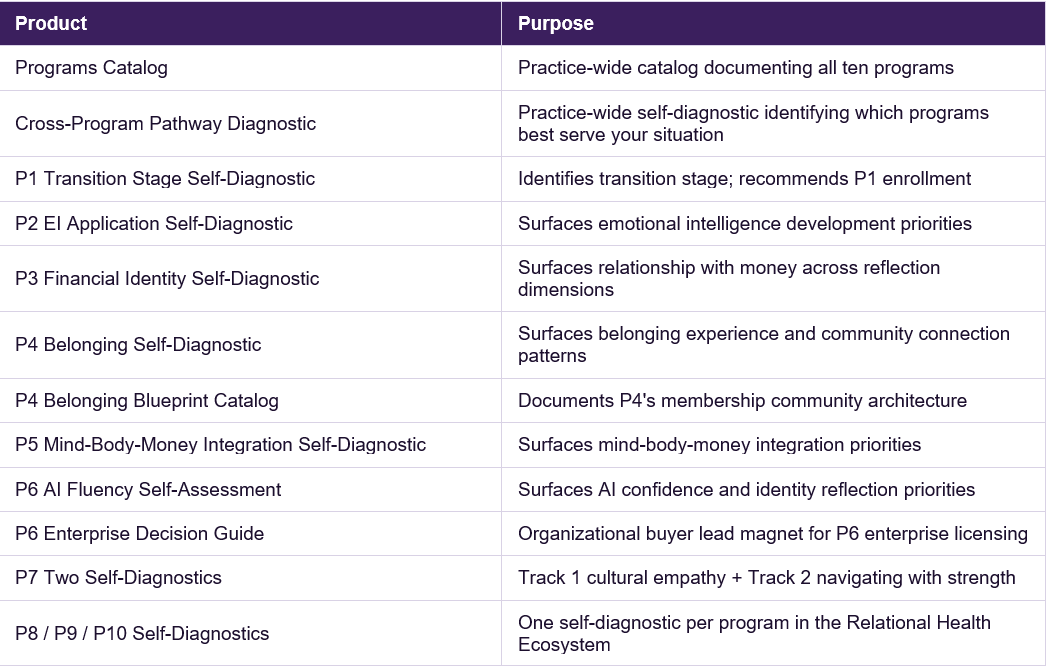
Beyond the cohort programs, the Programs practice offers an 18-product digital portfolio designed to serve participants who want substantive engagement with program content before committing to a cohort — or independently of cohort enrollment entirely.
Free Resources (12)
Paid Workbooks (6)
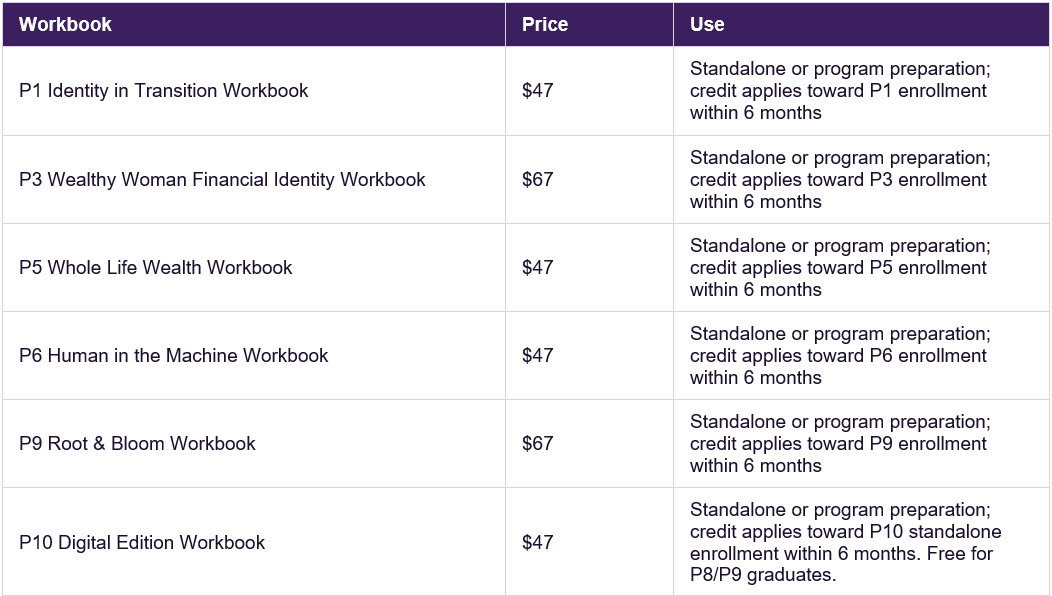
Workbook content for P2 The Emotional Edge, P7 The Empathy Effect, and P8 Groundwork is included with program enrollment rather than offered as a separate paid product.
Rewards Program
Programs participants earn credits across the engagement lifecycle that apply across CP4CD’s full service portfolio.
Paid workbook purchases produce credit equal to purchase price applicable toward subsequent program enrollment within 6 months. Above-and-beyond contributions during and after program participation — testimonials, case study participation, conference co-presentation, qualified referrals — produce credit that applies toward your own future engagements across any CP4CD program or service. Cross-program enrollment receives automatic discount as documented above.